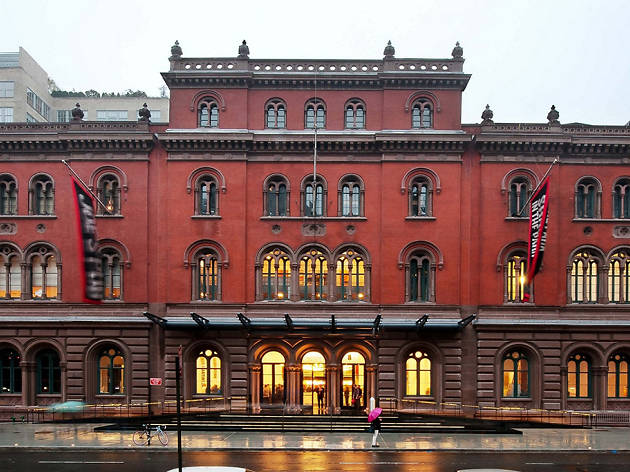
The Declaration of Independence: Long Trail to Liberty, is a special exhibition presented by The Berkley Collection and held at the Grey Art Museum at New York University. The exhibition explores the heart of the Declaration—the list of 27 justifications for revolution, known as “the grievances”. By examining each grievance in the context of numerous historical documents, letters, maps, and more, the exhibition reveals how Thomas Jefferson and the members of the Second Continental Congress turned recent and historical crises facing the colonists into a powerful argument for independence.
The show is on view through July 10th, 2026, and is completely free and open to the public.
To celebrate the 250th anniversary of the United States of America, the Berkley Collection presents The Declaration of Independence: Long Trail to Liberty. This exhibition tells the story of the increasingly troubled relationship between the British government and its colonies in the lead-up to the Revolutionary War. Including more than 100 historical documents of paramount importance, the exhibition provides valuable context for the colonies’ arguments for freedom that culminated in the Declaration of
Independence.
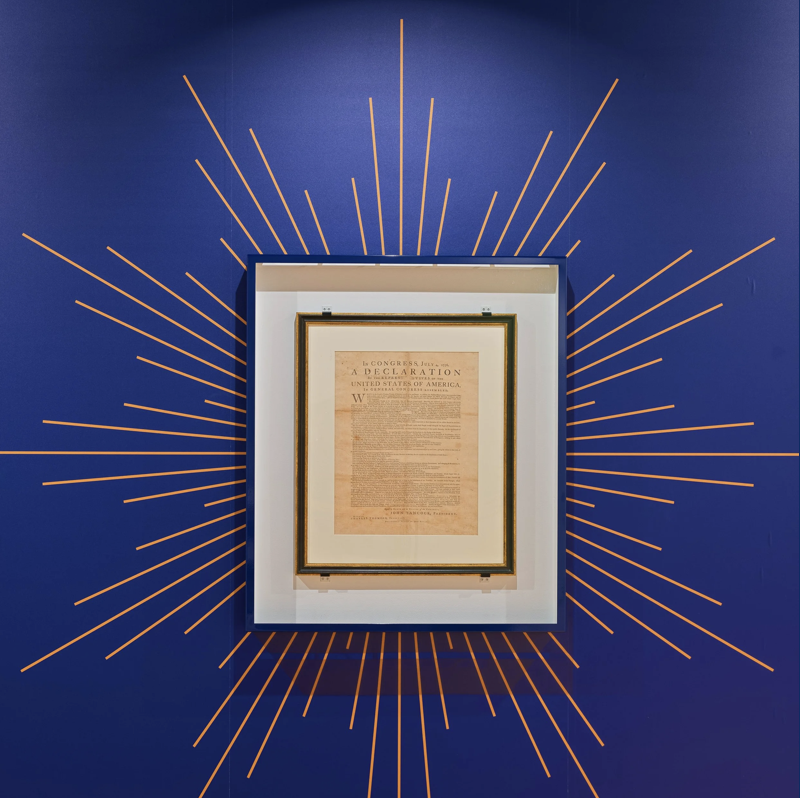
While nearly everyone is familiar with the Declaration’s famous preamble, The Declaration of Independence: Long Trail to Liberty will take visitors beyond “WE hold these Truths to be self-evident” and into the practical conflicts with the Crown that pushed the colonies toward revolution. The centerpiece of the exhibition is an original printing of the Declaration of Independence, pulled from John Dunlap’s press in Philadelphia between the evening of July 4 and the early morning hours of July 5, 1776—one of only 26 surviving today. By viewing this founding document alongside historical evidence of the events that necessitated its writing, visitors are invited to think about how creeping acts of tyranny—such as interference with private property and commerce, the suspension of colonial legislatures, and the massacre of everyday citizens—gradually made resistance inevitable.
“The grievances of the Declaration of Independence were not merely complaints,” said Joseph Newman, Head Curator at The Berkley Collection, “they were the reasons, assembled through time, that converted the concept of independence from an idea in to a moral imperative. As we celebrate America’s 250th anniversary, these arguments still resonate today. They shaped the country we’ve become.” Other highlights include a manuscript draft of the 1765 Stamp Act; a manuscript agreement from 1582 for discovering and settling land in the New World under Queen Elizabeth I, which later informed Thomas Jefferson’s argument for independence; a copy of Phillis Wheatley’s Poems on Various Subjects, Religious and Moral, signed in her own hand in rebuke of those who doubted a young Black woman could write such excellent verse; and manuscript instructions from King George III to William and Richard Howe, the King’s military leaders in North America, tasking them with repairing the peace. Also included is the first printing of the Articles of Confederation, the young nation’s first governing document, which not only represents our first attempt at truly independent self-governance, but formally cemented the name the United States of America.